





















Unveiling the Duel of Laser Wavelengths 905nm vs. 1535nm

Evaluating Laser Wavelengths
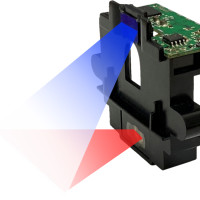
Wavelength plays a pivotal role in laser range finder modules, impacting their performance and capabilities. Lasers operate within different wavelength ranges, including ultraviolet, visible light, and infrared. In the context of range finding, we focus on the 905nm and 1535nm wavelengths. Both wavelengths have distinct features that warrant careful consideration.
- 905nm: 905nm NIR laser operates with semiconductor laser diode technology and falls within the range that silicon detectors can effectively detect, which is well-established, mature, and cost-effective.
- 1535nm: 1535nm laser exhibits strong atmospheric penetration ability, enabling long-range distance measurements in clear conditions.
Trade-offs to Consider
1. Atmospheric Penetration Ability
While 1535nm experiences lower atmospheric absorption and scattering compared to the 905nm wavelength, allowing for long-range measurement, it is crucial to consider its potential limitations. For instance, 1535nm lasers may have reduced performance in rainy or snowy weather conditions, since it is highly absorbed by water. Besides that, target reflectivity should also be taken into account when the surface is wet.
According to research, the absorption coefficient of water at 1535nm is approximately 253 times higher than the 905nm wavelength. We can easily say that the 905nm wavelength is more weather-proof than the 1535nm wavelength.

How does the industry overcome degradation in such critical environments?
- Signal Denoising Algorithm: Utilizing advanced algorithms such as Variational Mode Decomposition or CNN-based Lidar Point Cloud De-Noising to maintain performance in adverse weather.
- Increase Laser Power Output: Higher power increases the light intensity of the laser beam, making it more resilient and maintaining a stronger, clearer signal. However, higher power consumption generates more heat, which necessitates better cooling mechanisms to ensure the laser's long-term reliability.
2. Supply Chain Maturity
The implementation of 1535nm lasers often involves more complex technology, which can impact cost, size, and the maturity of the supply chain. Efficient heat dissipation also becomes crucial due to the higher power consumption of 1535nm lasers.
Photodiodes: InGaAs vs Si
| Compound | Pros | Cons |
| InGaAs | Low dark current High sensitivity (900-1700 nm) | High fabrication cost |
| Si | Cost-effective Large production volume | Reduced sensitivity range (below 1100nm) |
Silicon photodiodes exhibit lower sensitivity to the 1535nm wavelength due to their relatively high band gap energy of 1.1eV. However, this limitation is being addressed by Si photodiode hyperdoping (band gap engineering). Doping Si with Selenium effectively lowers the band gap energy, allowing the photodiode to detect 1535nm wavelength lasers (though this is currently in the development stage). Other SWIR sensors under development include InP, PbS, and GeS.

3. Eye Safety Considerations
When selecting the appropriate wavelength for a laser module, it is essential to consider potential effects on human eye safety. The 905nm wavelength falls within the "Retinal hazard region," making it less safe for the human eye.

A 905nm laser can penetrate the human eye, causing high energy to be focused on the retina and leading to irreversible damage. In contrast, the 1535nm wavelength is superficially absorbed by the cornea before reaching the retina, significantly reducing the potential for damage and making it a safer option. This absorption is due to the water content in the cornea's epithelium and endothelium layer.
WARNING: Prolonged Exposure Risks
While the cornea can tolerate some level of direct laser exposure (1400nm - 1000000nm), prolonged or intense exposure to 1535nm lasers might still lead to thermal damage to the corneal tissues. It is critical to adhere to strict safety guidelines.4. Ambient Light Interference
The Sun emits a broad spectrum of light, including visible, ultraviolet, and infrared wavelengths. However, solar radiation around 1500nm is relatively weaker compared to the visible light range (400nm-700nm). This characteristic reduces the likelihood of interference from sunlight, resulting in an improved Signal-to-Noise Ratio (SNR) for applications like LiDAR.

905nm vs 1535nm Wavelength Comparison Table
| Feature | 905nm | 1535nm |
| Eye Safety | Less safe (Retinal hazard) | More safe (Corneal absorption) |
| Detection Range | Longer within its wavelength range | Extended due to higher allowable power |
| Atmospheric Penetration | Weaker in clear conditions | Stronger in clear conditions |
| Performance in Rain/Snow | Better (lower water absorption) | Worse (high water absorption) |
| Cost & Maturity | More mature and cost-effective | Less mature and more expensive |
Market Adoptions
The industry is rapidly finding specific use cases tailored to the strengths of these wavelengths:
- Apple SWIR applications (e.g., skin-detect sensors in AirPods).
- Safety LiDAR for driving, particularly for monitoring critical conditions such as a driver losing consciousness or panicking.
- Multiple wavelength LiDAR systems.
- Earth-science surface discovering and topographic mapping.
What We Can Expect in the Future
As technology progresses, we anticipate several key developments in laser rangefinding:
- Energy-efficient and low-cost 1535nm implementations as supply chains mature.
- More cutting-edge denoising algorithms to overcome 1535nm's weather limitations.
- The rise of 1350nm laser applications bridging current technology gaps.
Conclusion
When selecting the appropriate wavelength for a laser range finder module, a careful evaluation of the advantages and disadvantages of 905nm and 1535nm is essential. The choice ultimately depends on the specific requirements of the application and the desired trade-offs. While 905nm lasers offer compatibility with silicon detectors, cost-effectiveness, and better performance in rain, 1535nm lasers provide significantly improved eye safety, superior atmospheric penetration in clear conditions, and extended measurement abilities at higher power. By considering these factors, designers can optimize laser range finder modules for their intended purposes, ensuring accurate and reliable measurements across a variety of scenarios.
Frequently Asked Questions
Why is a 1535nm laser considered safer for the eyes than a 905nm laser?
A 905nm laser falls into the retinal hazard region; it can penetrate the eye and focus energy directly on the retina, causing irreversible damage. A 1535nm laser is heavily absorbed by the water content in the cornea before it reaches the retina, significantly lowering the risk of severe internal eye damage.
Does a 1535nm laser rangefinder work well in the rain?
No, 1535nm lasers generally suffer in rainy or snowy conditions because water highly absorbs that specific wavelength (about 253 times more than 905nm). A 905nm laser is typically more weather-proof for precipitation.
Why are 905nm lasers cheaper than 1535nm lasers?
905nm lasers can use highly mature and mass-produced Silicon (Si) detectors, which are very cost-effective. 1535nm lasers require more expensive InGaAs detectors or complex emerging technologies because standard Silicon has low sensitivity at the 1535nm wavelength.
What is the advantage of using 1535nm for LiDAR in daylight?
Solar radiation around the 1500nm spectrum is much weaker compared to the visible light spectrum. This means 1535nm LiDAR experiences far less ambient light interference from the sun, resulting in a much better Signal-to-Noise Ratio (SNR) during the daytime.
References
- Löfgren, Stefan & Thaung, Jörgen & Lopes, Cesar. (2013). Laser pointers and eye injuries. An analysis of reported cases.
- Wojtanowski, J., Zygmunt, M., Kaszczuk, M., Mierczyk, Z., & Muzal, M. (2014). Comparison of 905 nm and 1550 nm semiconductor laser rangefinders’ performance deterioration due to adverse environmental conditions. Opto-electronics Review, 22(3).
- Singh, C., John, J., Singh, Y., & Tripathi, K. N. (2004). Indoor Optical Wireless Systems: Design Challenges, Mitigating Techniques and future Prospects. IETE Technical Review.
- D. Jain, S. Alam, Y. Jung, P. Barua, M. N. Velazquez, and J. K. Sahu, "Highly efficient Yb-free Er-La-Al doped ultra-low NA large mode area single-trench fiber laser," Opt. Express 23, 28282-28287 (2015).
- Mccally, Russell & Bargeron, C. & Bonney-Ray, Jennifer & Green, W.. (2005). Laser eye safety research at APL. Johns Hopkins APL Technical Digest.




Leave a Comment